
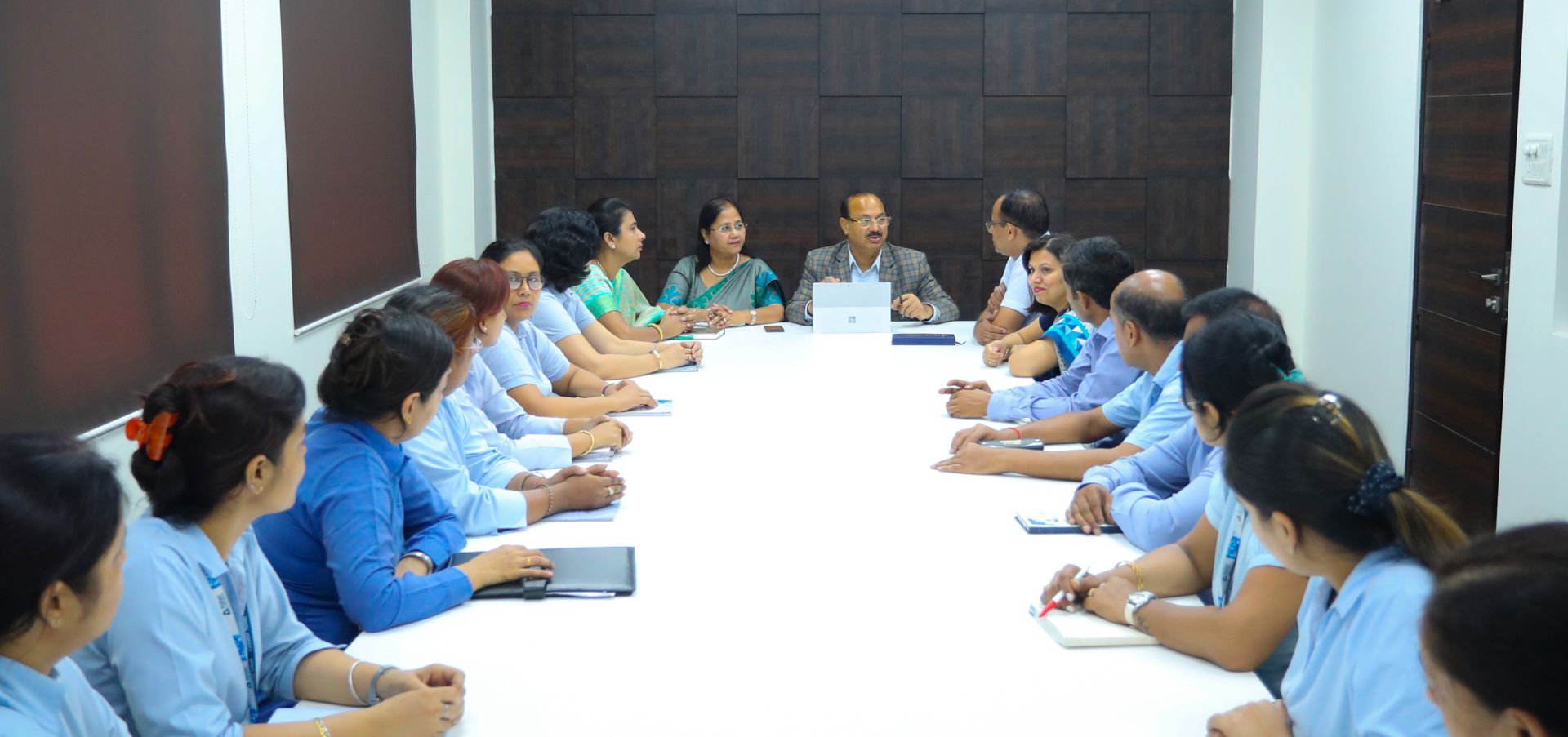
Aster Institutions is guided by visionary leadership, strong values and a deep commitment to creating meaningful educational opportunities for every generation.
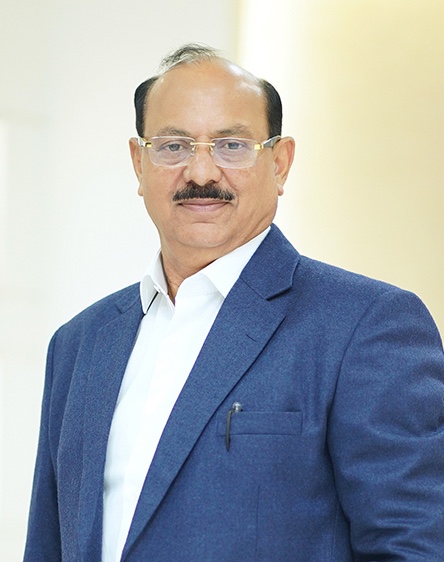
Every institution has a history. Some have a story worth telling.
Dr. V. K. Sharma’s journey is one of those stories.
Growing up in Delhi in a family of modest means, his early life was shaped by circumstances that demanded resilience, discipline and an extraordinary determination to succeed. Financial limitations were a reality, but they never became a limitation on his ambitions.
An exceptional student, he topped his school in the Class XII Board Examinations, setting the course for an academic journey that took him to Bhagat Singh College, University of Delhi, for a B.Com. (Honours), and subsequently to the Faculty of Law, University of Delhi, for his LL.B. He went on to earn an MBA and a Ph.D., pursuing education with the same conviction that would eventually define his life’s work.
His professional career began outside the world of education. Working across diverse industries and reputed organisations, he acquired the experience, managerial insight and understanding of people that would later prove invaluable. Yet, his aspirations extended beyond professional success. He wanted to build something that would outlast individual achievement—something that would create opportunities, influence lives and contribute to society long after its foundations had been laid.
In 1994, that aspiration took shape with the establishment of Aster Institutions. What followed was not merely the expansion of an educational organisation, but the gradual realisation of a deeply personal vision. Through changing times, evolving educational expectations and the challenges inherent in institution-building, Dr. Sharma remained steadfast in his belief that education must develop both the intellect and the individual.
Today, his legacy is reflected in the institutions he has nurtured, the opportunities they have created and the generations of students who have passed through their doors. For him, achievement has never been defined solely by professional recognition or material success. It is measured equally by the quality of one’s thoughts, the strength of one’s character and the purpose with which one lives.
A philosophy captured in the words he often reflects upon:
“The happiness of life depends upon the quality of one’s thoughts.”

The future of education cannot be built entirely on the systems of the past. This conviction shapes Siddharth Sharma’s approach to institutional leadership.
A law graduate from ILS Law College, Pune, Siddharth brings a structured, analytical and unconventional perspective to the management of educational institutions. His interest lies not simply in how schools’ function today, but in how they can function better tomorrow.
For him, a modern educational institution must operate with the sophistication of a well-managed organisation without losing the human values that define a school. That requires more than introducing new technology. It demands rethinking processes, questioning inefficiencies, standardising operations and designing systems that remain effective as institutions expand.
At Aster, his work spans institutional planning, technology integration, administrative automation, digital infrastructure and the development of scalable operational frameworks. He places particular emphasis on creating interconnected systems in which information flows seamlessly, decisions are supported by data and repetitive administrative responsibilities are reduced through intelligent processes.
His approach is pragmatic: innovation must solve a problem, improve an experience or create measurable value. Technology that merely replaces a manual process without improving its effectiveness serves little purpose.
Siddharth also recognises that institutional growth brings its own complexities. Maintaining consistency across multiple campuses requires clearly defined processes, accountability and an organisational structure capable of adapting without compromising standards. Rather than viewing these as administrative challenges alone, he sees them as opportunities to rethink the architecture of school management.
His objective is not simply to modernise Aster’s operations, but to build an institutional framework capable of supporting its ambitions for decades to come.
Siddharth believes that technology and innovation should serve a greater purpose in education—to simplify processes, strengthen institutions, and empower educators to focus on what matters most: student growth, learning, and success.

A school’s reputation may be built in its classrooms, but its reliability is established through everything that happens beyond them. This is the space in which Vaibhav Sharma makes his contribution to Aster Institutions.
With an MBA from London, Vaibhav brings a management-oriented outlook to the practical realities of running and developing educational campuses. His work is concerned with the details that often remain invisible when an institution functions well: coordinated operations, efficient resource allocation, infrastructure readiness, dependable services and the ability of different departments to work together without unnecessary complexity.
He approaches institutional management with a clear understanding that plans are only as effective as their execution. A new facility must be functional, not merely impressive. An administrative process must be dependable, not merely documented. An operational improvement must deliver results, not simply introduce change.
This emphasis on practical outcomes informs his involvement in campus development, operational management and the continuous improvement of institutional processes. Vaibhav’s management style combines systematic planning with responsiveness to everyday challenges. He values clear responsibilities, efficient coordination and timely decisions, recognising that operational consistency directly influences the experience of students, parents, teachers and staff.
As Aster Institutions continues to evolve, his contribution lies in ensuring that the organisation’s physical and operational capabilities keep pace with its aspirations.
For Vaibhav, excellence is not an occasional achievement. It is the result of getting the fundamentals right, consistently, every single day.

What makes a child curious? Why does one teaching method inspire understanding while another encourages memorisation? How can a classroom become a place where children learn to think rather than simply remember? These are the questions that inform Dr. Shruti Sharma’s approach to education.
A qualified medical professional, Dr. Shruti brings the discipline of scientific inquiry and an understanding of human development to her work at Aster Institutions. She views learning as a complex and deeply individual process, shaped by curiosity, environment, experience and the ability of educators to make knowledge meaningful. Her interest in curriculum development and teaching methodologies stems from a belief that education must evolve alongside our understanding of how children learn.
A classroom, in her view, should encourage questions before demanding answers. Concepts should be understood before they are memorised. And knowledge should find relevance beyond the pages of a textbook. This philosophy guides her emphasis on experiential learning, conceptual clarity, critical thinking and contemporary pedagogical practices.
She is particularly interested in creating learning environments that accommodate different abilities and encourage students to discover their own strengths. Academic rigour remains essential, but it must be complemented by creativity, independent thought and the confidence to explore unfamiliar ideas.
Teachers occupy a central place in this vision. Dr. Shruti believes that meaningful educational reform begins with educators who are encouraged to learn, experiment and continuously refine their methods. Curriculum innovation, therefore, must go hand in hand with teacher development and a culture of professional growth.
Her aspiration is to help create an academic environment in which learning is not experienced as an obligation, but embraced as a process of discovery. Because the true measure of education is not simply what a child knows today, but how confidently that child can learn, question and grow tomorrow.